Shiftr logo

Our blog

Stay in touch with the latest industry trends, market insights,and news shaping the world of tomorrow.

Custom Software vs Off-the-Shelf Software: Which Is Right for Your Business?

Custom Software vs Off-the-Shelf Software: Which Is Right for Your Business?

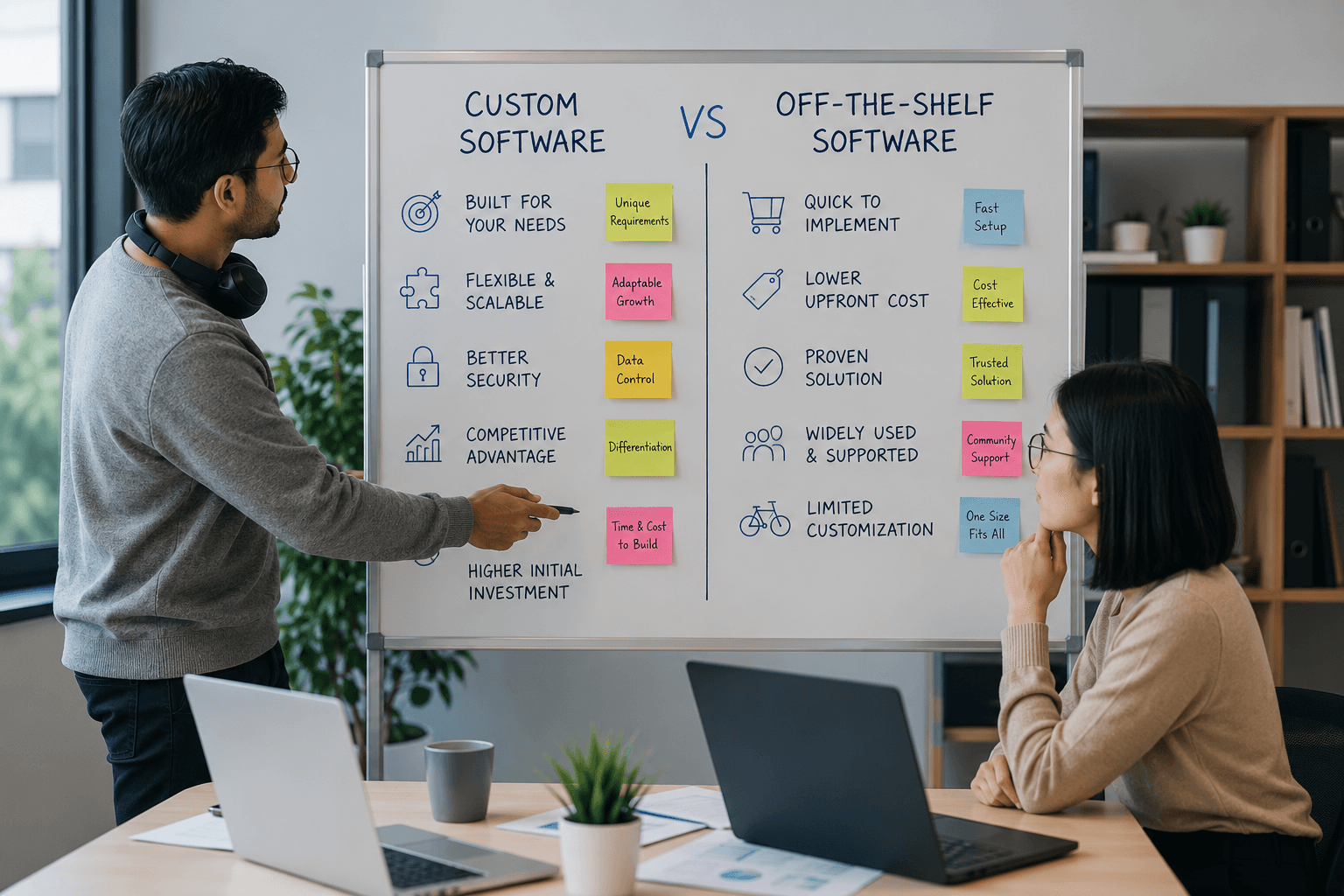
At some point, every growing business runs into the same problem. The tools that worked in the early days suddenly stop fitting the way the company operates. Maybe your team is juggling too many SaaS tools. Maybe your workflows are being forced into software that wasn't designed for your process. Or maybe you're paying for multiple subscriptions that still don't fully solve the problem. This is usually the moment when a key question comes up: Should we build custom software or just use an off-the-shelf solution? The answer isn't always obvious. Both options have clear advantages, but they solve very different types of problems. In this article, we'll break down the real differences between custom software and off-the-shelf tools, when each makes sense, and how to decide what is right for your business.

Jun 9, 2026SaaS6 min read
The Complete MVP Development Guide for Startups

The Complete MVP Development Guide for Startups

Every successful product starts with an idea. The challenge is turning that idea into something real without spending months of development time and exhausting your budget before you've even validated demand. That's where an MVP comes in. MVP stands for Minimum Viable Product. It's one of the most widely used approaches in modern product development because it helps startups test assumptions, gather feedback, and reduce risk before making larger investments. Yet many founders misunderstand what an MVP actually is. Some assume it's a low-quality version of a product. Others try to pack every feature into the first release and end up building something far bigger than necessary. The reality is much simpler: an MVP is the smallest version of your product that delivers meaningful value to users while helping you learn whether your idea solves a real problem. In this guide, we'll explore what an MVP is, why startups build them, how the development process works, and how to avoid common mistakes that can delay your launch.

Jun 9, 2026SaaS8 min read
Common Mistakes That Increase AI Development Costs

Common Mistakes That Increase AI Development Costs

Many AI projects become unnecessarily expensive, not because the technology is difficult, but because organisations begin development without a clear strategy. One of the most common mistakes is trying to solve too many problems at once. Companies often enter an AI project with a long list of desired features, only to discover that development timelines and budgets quickly spiral out of control. Another frequent issue is poor data readiness. Businesses may assume they have enough data to train an AI system, only to realise later that the information is incomplete, inconsistent, or spread across multiple systems. It's also common for organisations to focus on technology before identifying the business problem they want to solve. The most successful AI initiatives start with a clear objective, whether that's reducing customer support costs, improving forecasting accuracy, or increasing operational efficiency. A focused scope and realistic roadmap can save thousands of dollars and significantly reduce project risk.

Jun 9, 2026AI Tools4 min read
Why 90 Days Is Enough to Build a Successful MVP

Why 90 Days Is Enough to Build a Successful MVP

One of the biggest misconceptions in the startup world is that building a mobile application requires a year of development and a massive budget. In reality, many successful products started with a focused Minimum Viable Product (MVP) that was built in less than 90 days. The goal of an MVP is not to create the final version of your product—it's to launch a working solution that validates your idea, attracts early users, and provides valuable market feedback.

Jun 9, 2026Fintech2 min read
Common Mistakes That Increase AI Development Costs
Jun 9, 2026
4 min read
AI Tools

Common Mistakes That Increase AI Development Costs

Many AI projects become unnecessarily expensive, not because the technology is difficult, but because organisations begin development without a clear strategy. One of the most common mistakes is trying to solve too many problems at once. Companies often enter an AI project with a long list of desired features, only to discover that development timelines and budgets quickly spiral out of control. Another frequent issue is poor data readiness. Businesses may assume they have enough data to train an AI system, only to realise later that the information is incomplete, inconsistent, or spread across multiple systems. It's also common for organisations to focus on technology before identifying the business problem they want to solve. The most successful AI initiatives start with a clear objective, whether that's reducing customer support costs, improving forecasting accuracy, or increasing operational efficiency. A focused scope and realistic roadmap can save thousands of dollars and significantly reduce project risk.

In ipsam quis rem do
Jun 1, 2026
1 min read
AI Tools

In ipsam quis rem do

Lorem ipsum dolar sit amet minim lorerm ipsum dolar sit amet minimlorerm ipsum dolar sit amet minim. Lorem ipsum dolar sit amet minim lorerm ipsum dolar sit amet minimlorerm ipsum dolar sit amet minim.

How Much Does It Cost to Build a Mobile App in 2025?
May 28, 2026
3 min read
AI Tools

How Much Does It Cost to Build a Mobile App in 2025?

Lorem ipsum dolar sit amet minim lorerm ipsum dolar sit amet minimlorerm ipsum dolar sit amet minim. Lorem ipsum dolar sit amet minim lorerm ipsum dolar sit amet minimlorerm ipsum dolar sit amet minim.

Custom Software vs Off-the-Shelf Software: Which Is Right for Your Business?
Jun 9, 2026
6 min read
SaaS

Custom Software vs Off-the-Shelf Software: Which Is Right for Your Business?

At some point, every growing business runs into the same problem. The tools that worked in the early days suddenly stop fitting the way the company operates. Maybe your team is juggling too many SaaS tools. Maybe your workflows are being forced into software that wasn't designed for your process. Or maybe you're paying for multiple subscriptions that still don't fully solve the problem. This is usually the moment when a key question comes up: Should we build custom software or just use an off-the-shelf solution? The answer isn't always obvious. Both options have clear advantages, but they solve very different types of problems. In this article, we'll break down the real differences between custom software and off-the-shelf tools, when each makes sense, and how to decide what is right for your business.

The Complete MVP Development Guide for Startups
Jun 9, 2026
8 min read
SaaS

The Complete MVP Development Guide for Startups

Every successful product starts with an idea. The challenge is turning that idea into something real without spending months of development time and exhausting your budget before you've even validated demand. That's where an MVP comes in. MVP stands for Minimum Viable Product. It's one of the most widely used approaches in modern product development because it helps startups test assumptions, gather feedback, and reduce risk before making larger investments. Yet many founders misunderstand what an MVP actually is. Some assume it's a low-quality version of a product. Others try to pack every feature into the first release and end up building something far bigger than necessary. The reality is much simpler: an MVP is the smallest version of your product that delivers meaningful value to users while helping you learn whether your idea solves a real problem. In this guide, we'll explore what an MVP is, why startups build them, how the development process works, and how to avoid common mistakes that can delay your launch.

What Our Clients Say

We have served over 2500 clients in 20+ countries, and they have something to say about Shiftr

Mobile App

MT

Marcus T.

Founder & CEO

Speed + Quality

We had a tight investor deadline and needed a working product, not just a prototype. Shiftr delivered our cross-platform app in 11 weeks without cutting corners on quality. Every sprint demo gave us something real to show stakeholders. That kind of pace with that level of polish is genuinely rare.

SaaS

AL

Ariana L.

Founder & CEO

Non-technical founder + trust

I came in with a product idea and zero technical background. What impressed me most was that Shiftr never made me feel out of my depth. They translated every decision into plain language, walked me through the tradeoffs, and always explained the why behind their recommendations. I felt like a co-builder, not just a client.

Custom Software

DK

David K.

CTO

Long-term partnership + post-launch support

Most agencies disappear after launch. Shiftr did the opposite. Six months after we went live they are still actively involved, shipping new features, monitoring performance, and jumping on issues before we even notice them. That continuity is what sets them apart. We are not starting over with a new team every time we want to improve something.

Healthcare / Enterprise

NR

Natalie R.

VP of Clinical Informatics

Complex domain understanding

Building a HIPAA-compliant platform is not just a technical challenge, it requires a team that genuinely understands the regulatory environment and the clinical workflows behind the product. Shiftr got both. They asked the right questions from day one and built something our clinical staff actually wanted to use. Compliance was never an afterthought.

E-Commerce

JO

James O.

Director of Digital Product

Transparent process + clear communication

We had been burned by a previous agency that went quiet for weeks and then delivered something completely off-brief. With Shiftr it was the opposite experience. Weekly demos, a shared project board we could check any time, and direct access to the team on Slack. No surprises, no guesswork. We always knew exactly where things stood.

AI / ML

SM

Sofia M.

VP of Product

AI integration + business impact

We knew we wanted AI in our product but had no idea where to start or what would actually move the needle. Shiftr ran an assessment of our data and use cases before recommending anything. The recommendation engine they built increased our average order value by 28% within the first two months. They saved us from spending money on the wrong thing.

Let's Build Something
Great Together

Get Free Consultation